
DBE and heterochromia in Sphynx cats. Blue-eye genetics and informed breeding decisions
© Agnieszka Mianowska · Aggio Cat*PL · aggiocat.pl
Aggio Cat*PL Guide | Version with approved illustrations | 23 October 2026
Why can a Sphynx have intensely blue eyes without being white or colourpoint? What causes heterochromia in cats without DBE? Similar-looking eyes can have different genetic backgrounds. When assessing a cat and planning matings, it is therefore essential to distinguish the visible phenotype from the DNA test result.
1. How does eye colour develop?
Iris colour depends primarily on the amount and distribution of melanin and the way light is scattered. There is no blue pigment in the iris; the blue appearance results from light scattering within iris structures containing little melanin. This is sometimes described as the Tyndall effect, although the optical mechanism is more complex. Genes including TYR, KIT and PAX3 are relevant in cats, but they should not be treated as a single mechanism.
2. Heterochromia and dichromia
Complete heterochromia means that the two eyes differ in colour, while sectoral heterochromia means that one iris has two differently coloured areas. ‘Dichromia’ is sometimes used informally for two colours in one eye; in ophthalmic descriptions, ‘sectoral heterochromia’ (heterochromia iridis) is usually more precise when the two colours occupy distinct areas of the iris. There is no basis for claiming that this occurs only in cats with white markings.
Different eye colours may be associated with DBE, variants affecting melanocyte distribution, such as KIT variants, or other developmental mechanisms. Heterochromia describes a phenotype; it does not prove the presence of a particular PAX3 variant. Most kittens are born with bluish eyes, and the colour often matures at around 3–5 months of age, sometimes later.
3. Colourpoint, mink and sepia in relation to DBE
Alleles of the TYR gene are responsible for varieties including colourpoint (cs/cs), mink (cb/cs) i sepia (cb/cb). Blue eyes are characteristic of colourpoint, while aqua is typical of mink. A cat can carry a DBE variant alongside any of these genotypes. Intensely blue eyes in a colourpoint cat do not prove DBE.
| TYR genotype | Variety / meaning |
|---|---|
| cs/cs | colourpoint |
| cb/cs | mink |
| cb/cb | sepia |
| C/cs | full pigmentation at the C locus; carrier of the Siamese allele |
| C/cb | full pigmentation at the C locus; carrier of the Burmese allele |
© Agnieszka Mianowska · Aggio Cat*PL · aggiocat.pl
4. What does DBE mean, and how is it tested?
DBE stands for Dominant Blue Eyes. The molecularly characterised forms are associated with PAX3 variants. Expression can vary: a cat with the variant in question may have two blue eyes, heterochromia or no characteristic phenotype. Not every carrier therefore looks the same.
Publications describe different DBE variants and lines, including CEL, ALT, RE, AGO, NAD and MARU. A negative result applies only to the variants included in that test. Keep the variant name, laboratory details and full test report in the breeding records.
5. Glossary of notation used in the diagrams
| Notation | Meaning |
|---|---|
| N/N (PAX3) | the specific DBE variant under consideration was not detected |
| N/DBE | one copy of a specific DBE variant (simplified teaching notation) |
| DBE/DBE | two copies of the same DBE variant |
| N/DW (KIT) | dominant white allele |
| N/Ws (KIT) | white spotting allele |
| C/cs | carrier of the Siamese allele |
| C/cb | carrier of the Burmese allele |
The symbols N/DBE and DBE/DBE are simplified notation used to illustrate a cross involving a specific PAX3 variant; they are not universal labels for every form of DBE. The diagrams show genotype probabilities at fertilisation, rather than guaranteed numbers of kittens in a live litter.
6. DBE inheritance in practice
DBE × a cat without the tested variant
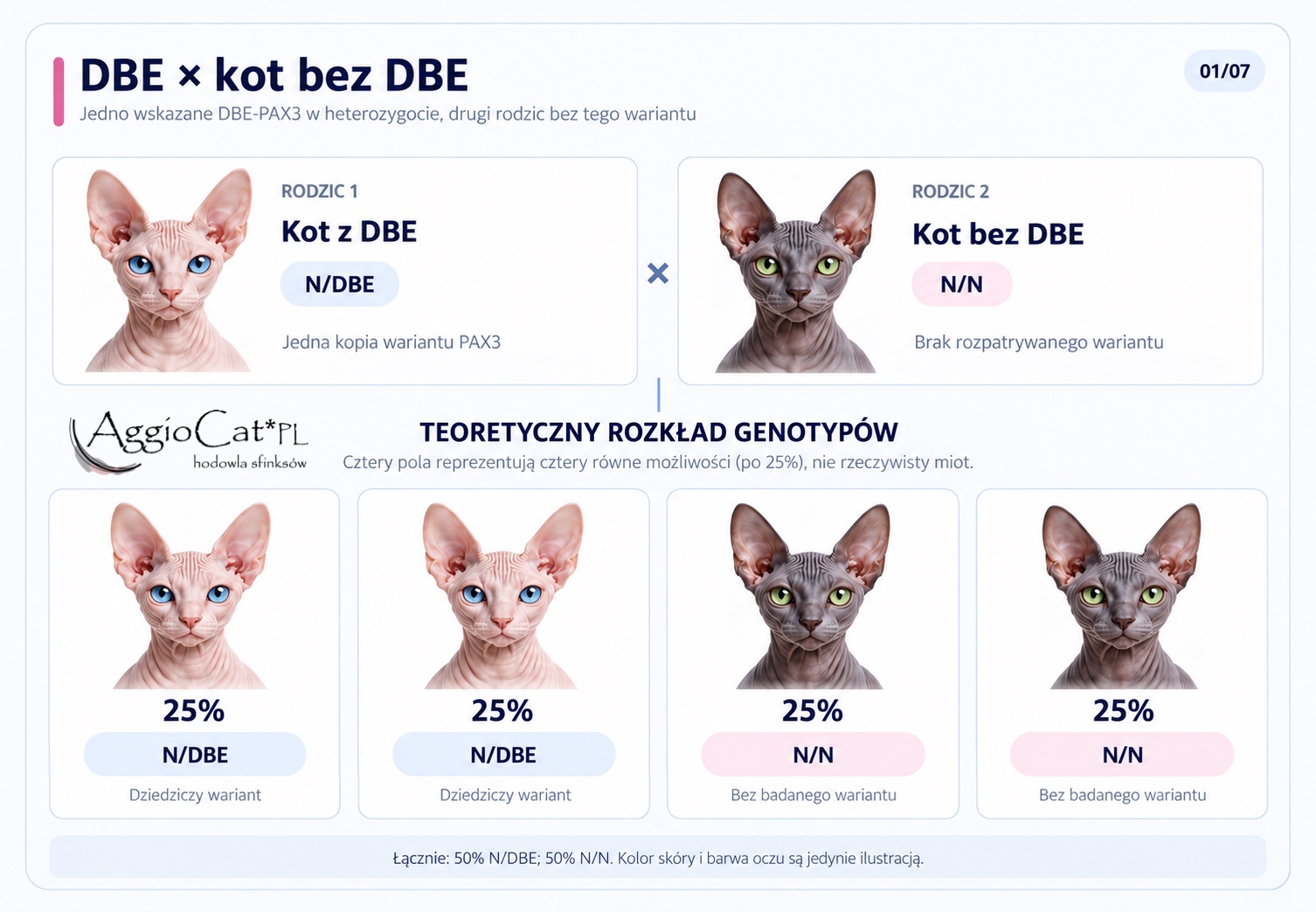
An N/DBE × N/N mating theoretically produces 50% N/DBE and 50% N/N offspring. Four boxes of 25% illustrate probabilities, rather than an actual litter. The skin and eye colours in the portraits are examples only.
DBE × colourpoint
Assuming the genotypes N/DBE; C/C × N/N; cs/cs all kittens will inherit C/cs, but statistically only half will inherit the DBE variant. None will be genetically colourpoint. This outcome does not automatically apply if the DBE parent has a different genotype.

DBE × mink
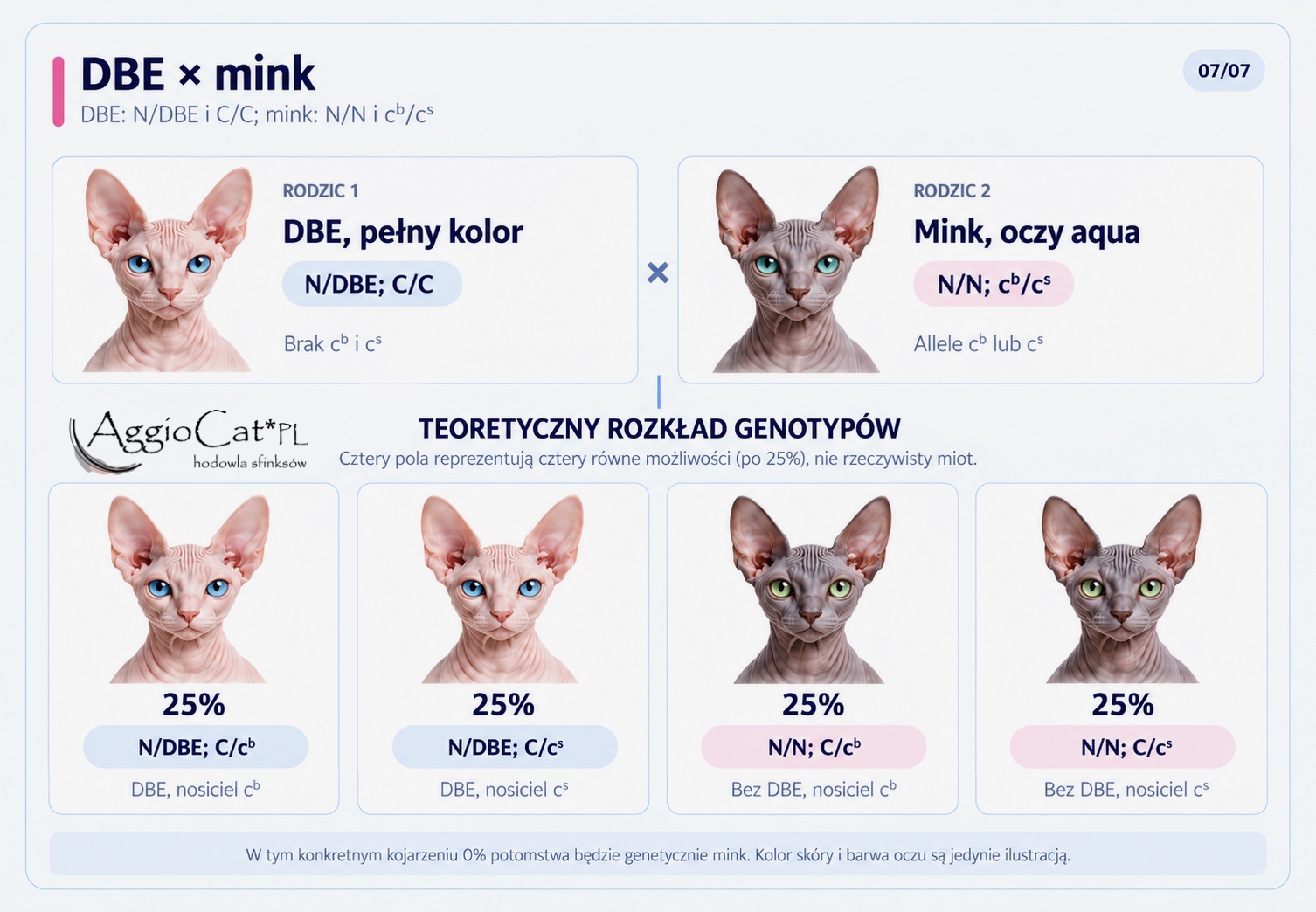
With N/DBE; C/C × N/N; cb/cs there are four equally likely combinations: N/DBE; C/cb, N/DBE; C/cs, N/N; C/cb and N/N; C/cs. In this particular mating, none of the offspring will be genetically mink. The mink parent’s aqua eyes are a phenotypic feature, and the offspring’s appearance in the diagram is illustrative.
DBE × DBE: particular caution is needed
For two parents heterozygous for THE SAME variant, the distribution at fertilisation is 25% N/N, 50% N/DBE and 25% DBE/DBE. The effects of homozygosity depend on the variant. Serious developmental consequences and threats to survival have been described in some lines; the 25% must not be interpreted as predicting the birth of a healthy homozygote. Mating two DBE cats is not recommended.

7. DBE, dominant white and white spotting
A cat with DBE may have intensely pigmented skin without white markings. It may also have small white areas associated with expression of the particular PAX3 variant, or an independent KIT white variant. Skin appearance alone does not establish the cause of blue eyes.
DBE × KIT white spotting
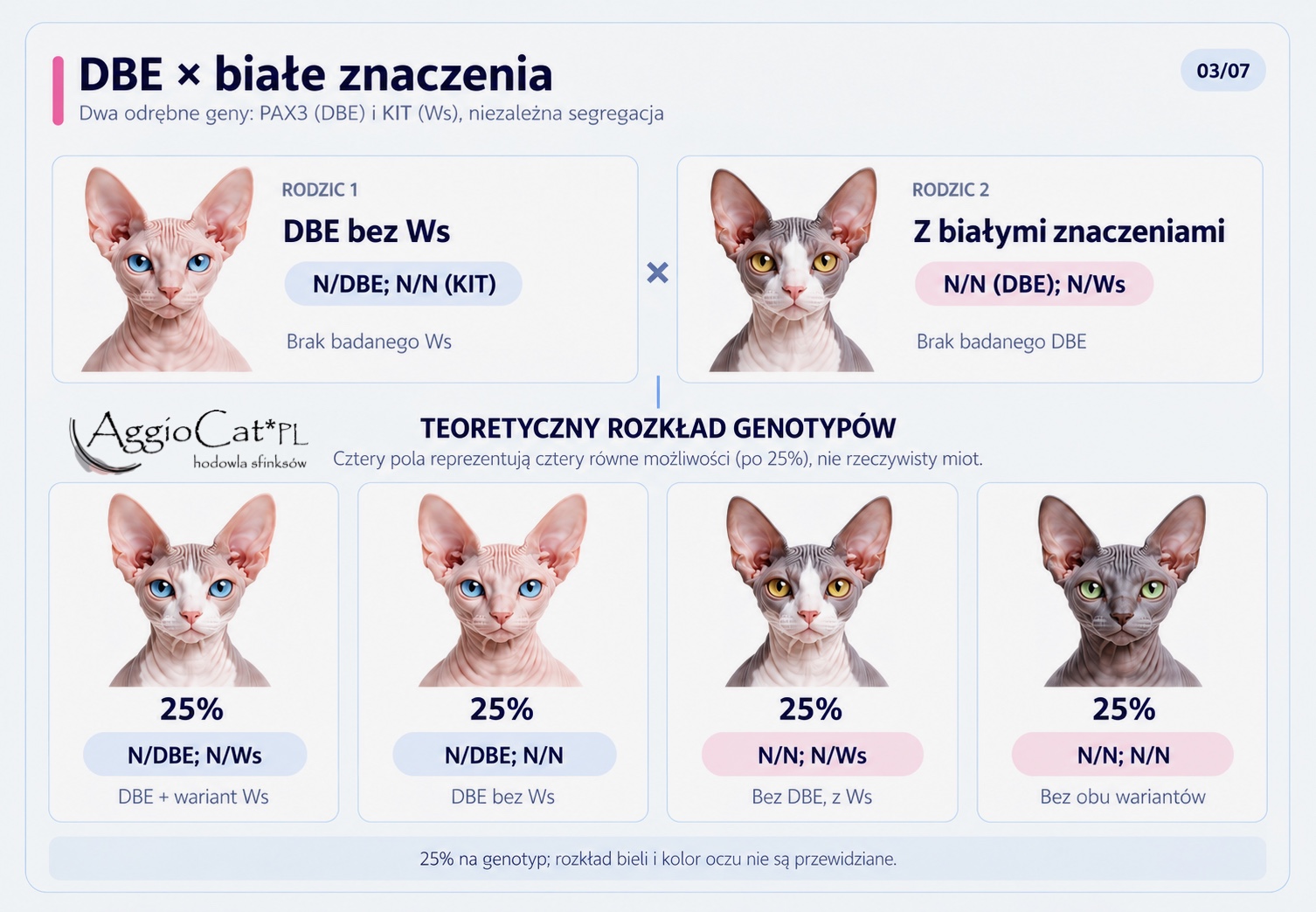
For two independent loci, with parents N/DBE; N/N (KIT) and N/N (tested DBE variant); N/Ws (KIT), each of the four genotype combinations has a 25% probability. This does not, however, determine the extent of white or the likelihood of heterochromia.
KIT dominant white (DW)
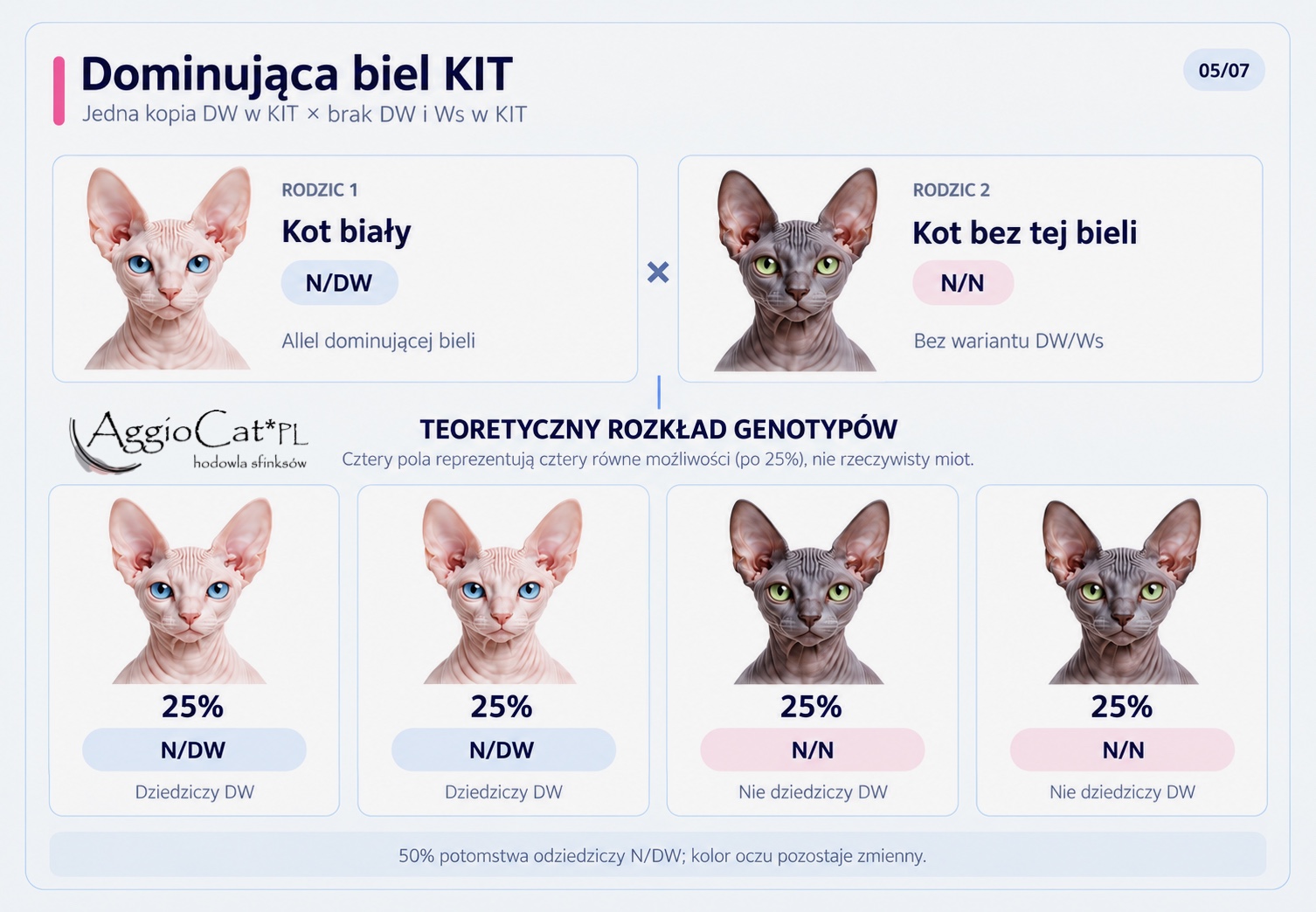
With N/DW × N/N, half of fertilisations produce N/DW and half N/N. The blue eyes in the diagram are examples only: the genotype alone does not determine their exact colour.
KIT white spotting (Ws)
With N/Ws × N/N, the probability of passing on Ws is 50%. The distribution and extent of white markings may vary despite an identical genotype at the tested locus. DW and Ws are alleles associated with the same KIT gene, rather than two separate genes.

© Agnieszka Mianowska · Aggio Cat*PL · aggiocat.pl
8. Hearing and health implications
Blue iris colour does not itself cause deafness. However, abnormalities in melanocyte development can affect inner-ear function. The association between KIT dominant white and deafness must be distinguished from the risk profile of individual DBE/PAX3 variants. Not all DBE cats are deaf; this does not mean that every variant is safe either.
BAER testing provides an objective assessment of hearing in each ear separately. BAER results and genetic tests answer different questions and do not replace one another. Normal hearing in an individual cat also does not establish the effects of homozygosity in that line.
9. Informed selection of breeding pairs
Before mating, it is useful to know the specific DBE variant, the scope of testing, hearing-test results, TYR and KIT genotypes, pedigree and history of previous litters. Heterochromia in a cat testing negative for the variant investigated does not establish its cause. Matings between two DBE cats, including those with different variants, should be avoided because of the reported interactions and risks.
10. EMS and federation rules
EMS describes phenotype, rather than genotype: 61 denotes deep blue eyes, 63 heterochromia, 66 aquamarine and 67 intense Siamese-type blue. EMS code 63 must not be equated with a particular DBE variant.
Rules differ between organisations and breeds. FIFe restrictions on PAX3 variants in Maine Coons do not automatically mean a ban for Sphynx cats. An August 2024 PZF announcement reported WCF show restrictions concerning DBE. Before entering a particular cat, check the relevant federation’s current registration, breeding and show rules; these are separate issues.
11. Frequently asked questions
Does every blue-eyed Sphynx have DBE?
No. Blue eyes can result from colourpoint or other mechanisms.
Does heterochromia prove DBE?
No. It describes a phenotype whose underlying cause can vary.
Does an N/DBE cat always have blue eyes?
No. Some variants show variable expressivity and incomplete penetrance.
Does a negative test exclude all forms of DBE?
No. The result applies to the variants tested.
Should two DBE cats be mated?
This is not recommended because of the possible effects of homozygosity and interactions between variants.
© Agnieszka Mianowska · Aggio Cat*PL · aggiocat.pl
Summary
Heterochromia and DBE are not synonyms. Understanding the differences between PAX3, KIT and TYR helps interpret eye colour more accurately and make informed mating decisions. All seven approved illustrations show specific, simplified inheritance models, rather than certain predictions of a future litter’s appearance or health.
Further information
Abitbol et al. (2024), Different Founding Effects Underlie Dominant Blue Eyes (DBE) in the Domestic Cat, Animals 14(13), 1845. DOI: 10.3390/ani14131845.
Abitbol et al. (2026), Additional PAX3 Variants for Dominant Blue Eyes in Cats, Animal Genetics. DOI: 10.1002/age.70199.
UC Davis Veterinary Genetics Laboratory: Dominant White & White Spotting and Colorpoint Restriction: https://vgl.ucdavis.edu/.
FIFe: EMS, SPH standard and Breeding & Registration Rules: https://fifeweb.org/.
PZF: announcement concerning the WCF General Assembly: https://pzf.pl/walne-zgromadzenie-czlonkow-wcf/.
© Agnieszka Mianowska · Aggio Cat*PL · aggiocat.pl