
Canadian Sphynx health
© Agnieszka Mianowska · Aggio Cat*PL · aggiocat.pl
Facts and myths
Sphynx cats are not inherently sickly. Their appearance does raise many questions, however, and online opinions often bear little resemblance to reality. Let’s look at what is known about Sphynx health, what deserves attention and when veterinary help is needed.
- Myth 1: Sphynx cats are unusually sickly
- Myth 2: Every Sphynx will develop heart disease
- Myth 3: Sphynx cats have exceptionally sensitive intestines
- Myth 4: Bare skin means poor health
- Myth 5: A Sphynx is always cold
- Myth 6: Discharge always means disease
- Myth 7: Sphynx cats live for only six years
- How to look after your Sphynx’s health
Myth 1. Sphynx cats are unusually sickly
Not true. Having no fur does not mean weak immunity or a need for constant treatment. A healthy Sphynx is an active cat that needs attention to nutrition, preventive care and comfort, just like other cats.
It is nevertheless worth understanding the breed’s actual health predispositions. This makes it easier to recognise problems early and, above all, to distinguish signs of illness from normal Sphynx characteristics.
Myth 2. Every Sphynx will develop heart disease
Not true. Hypertrophic cardiomyopathy (HCM) can occur in pedigree and non-pedigree cats. Breeds in which particular attention is paid to HCM risk include Maine Coons, Ragdolls, British cats and Sphynx cats. This does not mean that Sphynx cats are affected most often or that every cat of the breed will develop it. HCM can progress for a long time without visible signs, which is why heart examinations are so important.
The most important examination is an echocardiogram performed by a veterinarian who practises cardiology and has extensive experience in feline echocardiography, particularly HCM assessment. This involves more than simply performing ultrasound scans: it requires accurate measurements of heart structures, interpretation of the images and the ability to distinguish disease from normal variations. Participation in a recognised international cardiac screening programme and the ability to issue breeding-screening certificates are additional advantages.
It is worth checking the list of veterinarians approved for the PawPeds HCM screening programme. The Polish section lists three people, all based in Warsaw. Travelling there may be difficult for owners who live far from the capital. However, this does not mean that competent feline cardiology practitioners cannot be found outside the PawPeds list.
I recommend a first preventive echocardiogram after a Sphynx turns one year old. For a healthy companion cat with a normal initial result, an approximate 1–3–5 plan can be discussed with the cardiologist: checks at around one, three and five years of age. The first examination and subsequent care in accordance with the veterinarian’s advice are the priorities. This is a proposed plan for an individual cat, not a universal rule for the breed. An abnormal result, family history or symptoms may require an earlier follow-up. After the age of five, screening should continue at intervals agreed with the cardiologist.
Breeding cats should have an echocardiogram before their first mating and at least once a year thereafter. A normal result describes the heart on the day of the examination; it does not guarantee that disease will never develop.
Sphynx cats can also be tested genetically for a variant in the ALMS1 gene, but the result cannot reliably predict whether a cat will develop HCM. A Sphynx with a positive result may never become ill, while one with a negative result may still develop the disease. DNA testing does not replace regular repeat echocardiography.
More information is available in the separate Guide article ‘HCM in Sphynx cats’.
Myth 3. Sphynx cats have exceptionally sensitive intestines
Not true. A healthy Sphynx digests food normally and passes formed stools, just like any other healthy cat. Recurrent diarrhoea is not a breed characteristic; it is a sign whose cause must be investigated.
Where, then, does this myth come from? One possible reason is infections that spread easily in larger groups of cats, including catteries. Intestinal parasites, including protozoa such as Giardia and Tritrichomonas, can cause diarrhoea. Similar signs occur with bacterial infections, food allergies, dietary intolerances and other gastrointestinal diseases. Food should not automatically be blamed, nor should infection be assumed from the outset.
For persistent signs, the veterinarian may recommend faecal tests for parasites, including protozoa, along with appropriate antigen tests, PCR or bacteriological testing. Not every cat needs a full panel immediately. Repeated food changes will not eliminate an infection: diet can support treatment, but cannot replace identifying the cause. I discuss this further in ‘Intestinal parasites and infections in cats’.
© Agnieszka Mianowska · Aggio Cat*PL · aggiocat.pl
Myth 4. Bare skin means poor health
Not true. A Sphynx’s bare skin is not inherently diseased or exceptionally delicate. It is elastic and can be quite resilient to everyday minor injuries. Without fur, however, scratches, redness and other changes are easier to see. This is an advantage because problems can be noticed quickly, but it also makes harmless marks more visible than on a coated cat.
There is no basis for assuming that every Sphynx is more prone to food or environmental allergies than other cats. Any cat can develop these allergies. Their signs may simply be easier to spot on bare skin. Persistent itching, small bumps or redness call for investigation, rather than choosing cosmetics or medicines yourself.
A 2010 study by Volk and colleagues found greater colonisation of selected skin areas by Malassezia yeasts in 18 healthy Sphynx cats than in healthy cats from the comparison groups. Colonisation means that microorganisms are present on the skin and is not, in itself, a disease. Treatment is determined by the signs and examination findings, not merely by a yeast’s name on a laboratory report.
Sphynx skin produces natural oily secretions, just like the skin of other cats. Because it lacks a conventional coat, soiling may be more visible. This does not mean frequent bathing is necessary. Excessive washing and irritating products can worsen the skin’s condition. Sphynx cats also need protection from strong sunlight, burns and chilling. I explain the details in ‘Sphynx grooming’.
Myth 5. A Sphynx is always cold
Not true. Sphynx cats do like warmth, but they do not need a tropical temperature at home. They should have access to a soft, warm bed and blankets, while also being able to move somewhere cooler. Observe where your cat chooses to rest.
A Sphynx taken out from under a duvet may feel very hot to the touch. This does not mean it has a fever. A Sphynx’s normal internal temperature falls within the same range as that of other cats. Without fur, the warmth of the skin is easier to feel. Fever should not, however, be assessed by touch alone. If the cat is lethargic or has other signs of illness, its temperature needs to be measured and veterinary advice sought.
Myth 6. Eye or ear discharge always means disease
Not always. Sphynx cats may have visible secretions in their ears and a small amount of discharge in the corners of their eyes. Not all discharge is normal, however. Its appearance, quantity and any accompanying signs matter.
In a Sphynx’s ears, wax and natural oily secretions can form a dark, greasy deposit that resembles mud if care is neglected. Inspect the ears regularly and gently remove visible dirt, usually every week or two, depending on the individual cat’s needs. There is no need to aim for perfect cleanliness or to clean deep inside the ear canal. An unpleasant smell, itching, redness, pain or head shaking calls for a veterinary ear examination and, where needed, microscopic examination of the discharge. Do not treat ears yourself based solely on the colour of the wax.
Sphynx cats usually have no eyelashes. A small amount of thick discharge, resembling the ‘sleep’ found in human eyes, may collect in the corner of a healthy cat’s eye. It can be removed carefully with soft gauze moistened with saline, without rubbing the surface of the eye. Healthy eyes do not need to be rinsed every day.
Excessive watering, redness, swelling, pain or squinting requires prompt veterinary assessment, ideally by a veterinary ophthalmologist. Entropion and corneal sequestra are among the conditions reported in Sphynx cats, so eye problems should not be dismissed. Do not use medicated eye drops or homemade tea compresses without veterinary advice.
Myth 7. Sphynx cats live for only six years
Not true. A single statistical finding cannot be treated as a lifespan prediction for every Sphynx. It is essential to know how many cats were analysed, what data were collected and the limitations of the method.
In 2024, a British VetCompass study attracted considerable attention. It estimated life expectancy at birth for Sphynx cats at 6.68 years. However, the calculation for this breed was based on just 18 deceased cats. Such a small subgroup makes the estimate highly uncertain: its 95% confidence interval ranged from 4.53 to 8.83 years.
The data came from British veterinary practice records. However, the publication does not provide individual health histories or causes of death for those 18 Sphynx cats. Nor does it establish whether they came from catteries, shelters or other backgrounds. Presenting ‘Sphynx cats live for 6–7 years’ as an established fact about the entire breed on this basis is an unjustified generalisation. A finding from such a small subgroup requires cautious interpretation and investigation in a larger number of cats. It is not a reliable lifespan prediction for an individual Sphynx.
A Finnish questionnaire study published in 2016 included 8,175 cats, of which 272 were Sphynx cats. It concerned health and behaviour. Although the cats’ ages were recorded, it was not designed to calculate Sphynx life expectancy. Its findings therefore cannot be compared directly with VetCompass.
A different picture of cats’ ages is provided by a 2026 survey by the Finnish association Sfinxit ry. It collected information on 79 deceased and 210 living Sphynx cats. Of the deceased cats, 43 had lived to at least 11 and 18 to at least 14. Among the living cats, 55 were already at least 11. These data show that Sphynx cats can live considerably longer. However, the survey was not representative of the entire population and cannot establish the breed’s average lifespan or directly validate the VetCompass estimate.
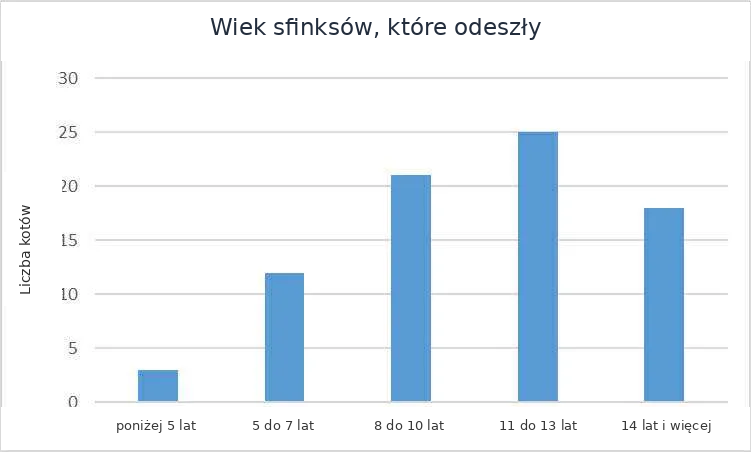

An individual cat’s lifespan depends on many factors: health, inherited risks, preventive care, living conditions and access to treatment. Rather than relying on one widely reported number, ask the breeder about the parents’ screening, relatives’ health and how the cats are monitored over the years.
© Agnieszka Mianowska · Aggio Cat*PL · aggiocat.pl
How to look after your Sphynx’s health
Beyond heart checks, a Sphynx needs the same basic healthcare as other cats. Lifestyle-appropriate vaccinations, sensible parasite prevention, dental care, good nutrition and regular veterinary check-ups all matter. The absence of fur alone is not a reason for a long list of additional tests.
Recurrent diarrhoea, weight loss, skin changes, lethargy and sudden behavioural changes require veterinary advice. If a cat has difficulty breathing, breathes with an open mouth, faints or suddenly loses the use of its limbs, seek veterinary help immediately.
Sources and further reading
Sfinxit ry, 2026. Survey results on the ages of living and deceased Sphynx cats, presented in two original charts.
Teng et al., 2024, Life tables of annual life expectancy and risk factors for mortality in cats in the UK; British VetCompass study, including a subgroup of 18 Sphynx cats.
Vapalahti et al., 2016, Health and Behavioral Survey of over 8000 Finnish Cats; a questionnaire study, not a Sphynx life table.
ABCD; Guidelines for feline trichomonosis; Tritrichomonas infection, PCR diagnosis and the limitations of repeated dietary changes.
CAPC; Giardia; diagnosis of giardiasis in cats.
ACVIM; Consensus statement on feline cardiomyopathies; principles of cardiac diagnosis in cats.
WCF. Welfare Commission newsletter, October 2025. The resource recommends annual heart screening; it is not the source of the 1–3–5 plan presented in this article as a proposal to discuss individually with a cardiologist.
WSAVA; Vaccination Guidelines; vaccination recommendations.
Sarfaty et al., 2022. Eye diseases in Sphynx cats referred to a specialist ophthalmology clinic. The findings concern the clinic’s patient population, not all Sphynx cats.
Volk A.V. et al., 2010. Malassezia pachydermatis and M nana predominate amongst the cutaneous mycobiota of Sphynx cats. A study of skin colonisation in healthy Sphynx cats.
© Agnieszka Mianowska · Aggio Cat*PL · aggiocat.pl